



Skip to content
LIVING EASEL

Modular Public-Space Cooling Infrastructure

Cooler streets. Cooler transit.

Modular shade, seating, native greenery, and water infrastructure that improves rider comfort, connects people to local culture and businesses, and makes public spaces more accessible.

Developed bySmall Green Door+Spout+VibePass

01 · The Problem

24%

Only 24% of LA County bus stops offer shade / modular shelter.

Los Angeles is getting hotter, yet most places where people wait, walk and gather still lack shade, seating and access to water. Shade alone can reduce people’s experience of heat by nearly 10°F.

Source: LA Metro Bus Stop Hub (2022) and Metro Heat Mitigation program. Metro does not endorse this proposal.

02The Living Easel Platform

Built from Restored & Sustainable Materials. Modular shade, seating and water with Spout.

The frame is the structural backbone for modular shade, accessible seating and a atmospheric water module proposed for development with Spout. The module is intended to generate filtered public drinking water from ambient air without a permanent municipal water line, subject to collaborative engineering, testing and public-health review.

  1. 01Structural steel uprights + crossbeamsRestored heavy-gauge steel, repurposed from mural rigging and industrial racking.
  2. 02Slotted pin connectionsModular slotted uprights accept beams at set intervals for rapid field assembly.
  3. 03Surface bolt-down anchor platesBaseplates bolt to existing paving for non-invasive civic footings.
  4. 04Artist canopy attachment pointsUpper tower bracing receives tensioned, artist-designed shade panels.
  5. 05Atmospheric misting + water module bay with SpoutProposed bayProposed bay for a purpose-built, weather-resistant atmospheric water generator developed with Spout, powering controlled public misting for heat relief, with multi-stage filtration, secure storage and a proposed accessible bottle-refill station. Designed to avoid water-line trenching and permanent water-utility connections; solar, battery or grid power will be evaluated.
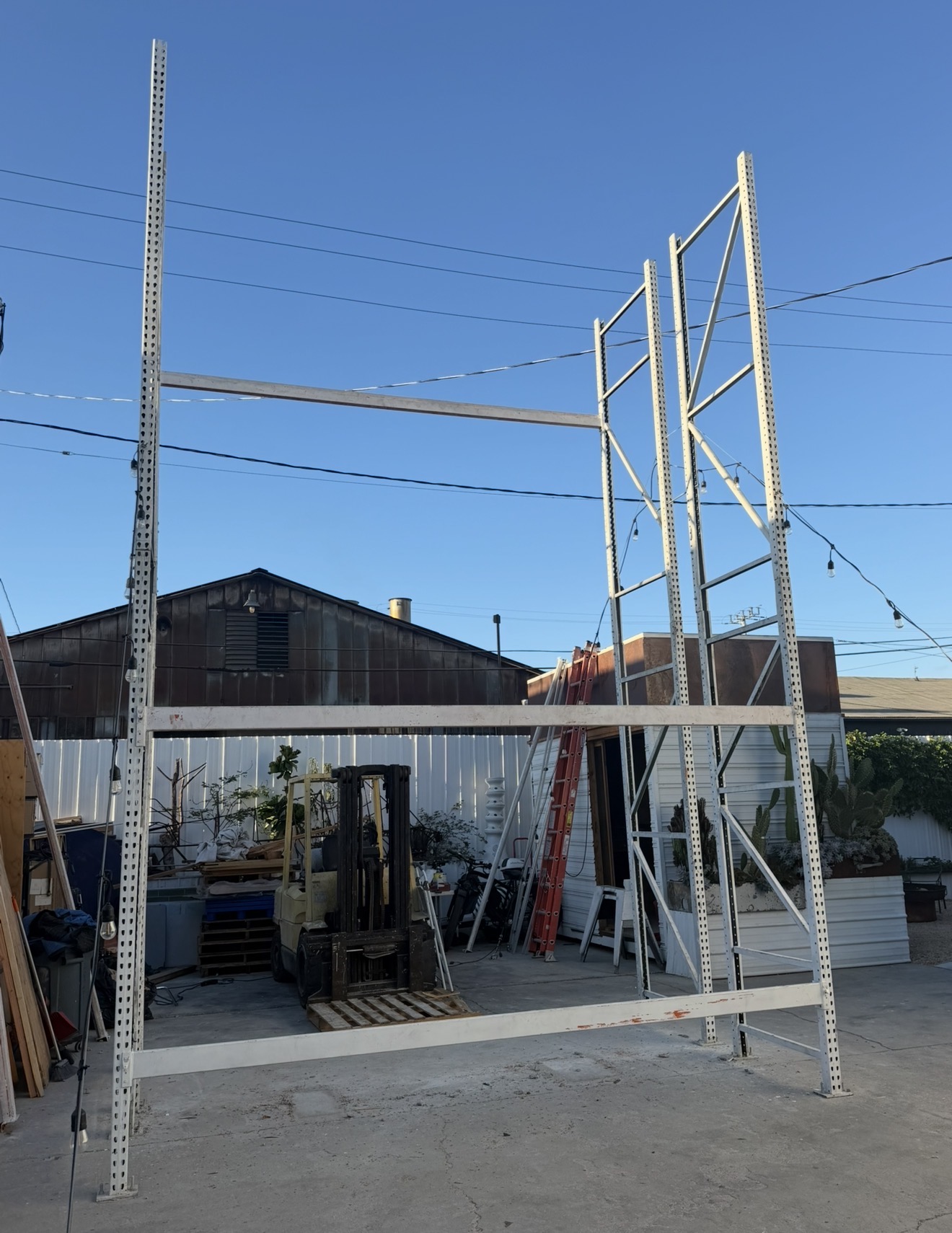
The physical Living Easel frame: restored white perforated steel uprights and crossbeams, partially assembled in the Small Green Door studio yard.
Fig. 02 — Frame in assemblySmall Green Door studio yard · Los Angeles

05 marks a proposed integration area only. The Spout water module is not installed in this studio frame; its location and design will be determined through engineering and testing.

Material palette · Studio prototypes

Paired with the frame: benches and a communal planter table fabricated in the same studio.

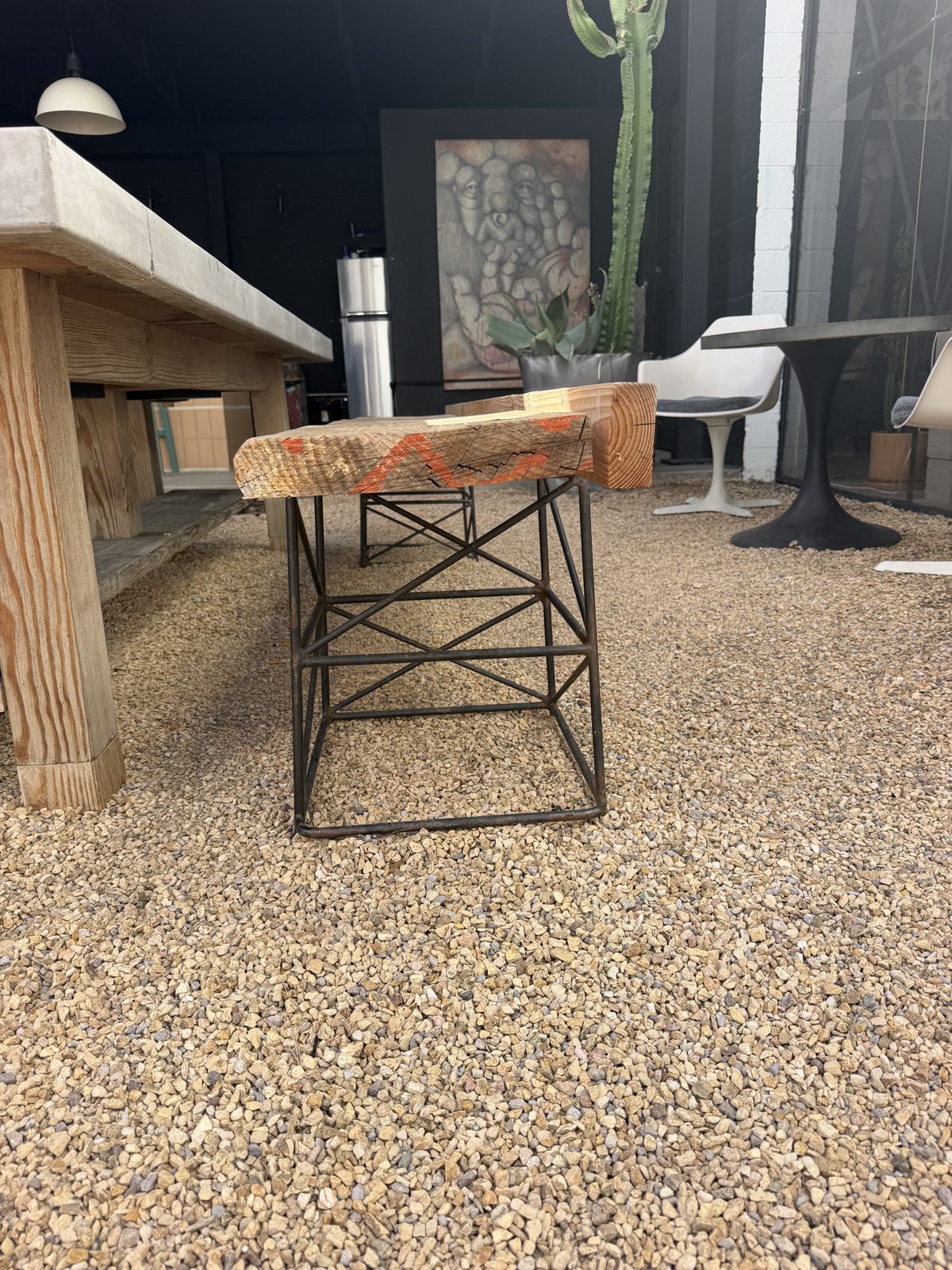
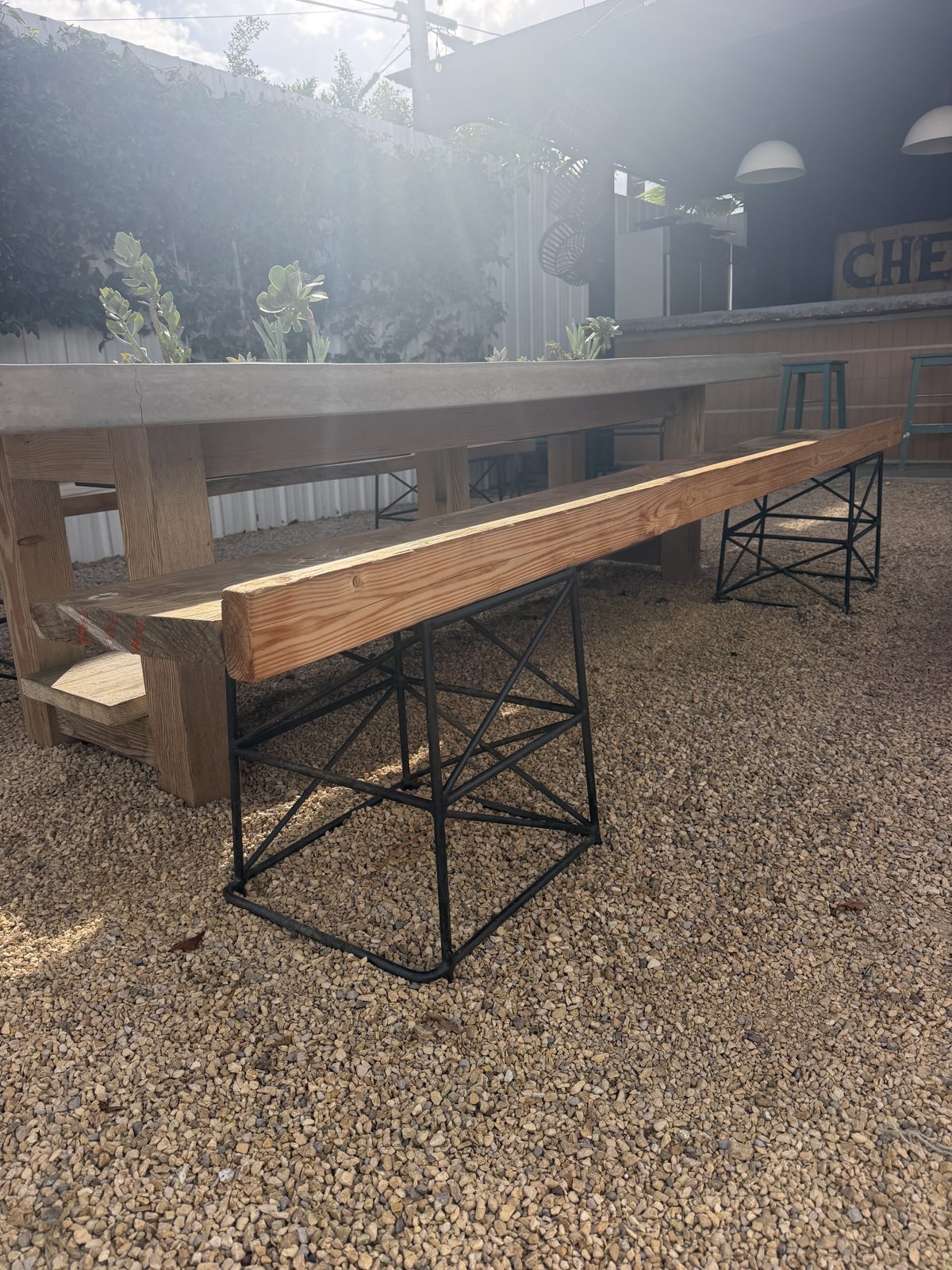
  • End view of the timber bench showing painted end grain and the welded steel rod truss base.
    M-01 · Steel

    Raw restored steel

    Perforated uprights, beams and welded rod truss bases.

  • Long reclaimed solid timber bench resting on two welded black steel truss bases, on gravel.
    M-02 · Timber

    Solid reclaimed timber

    Full-section bench seats on welded architectural truss bases.

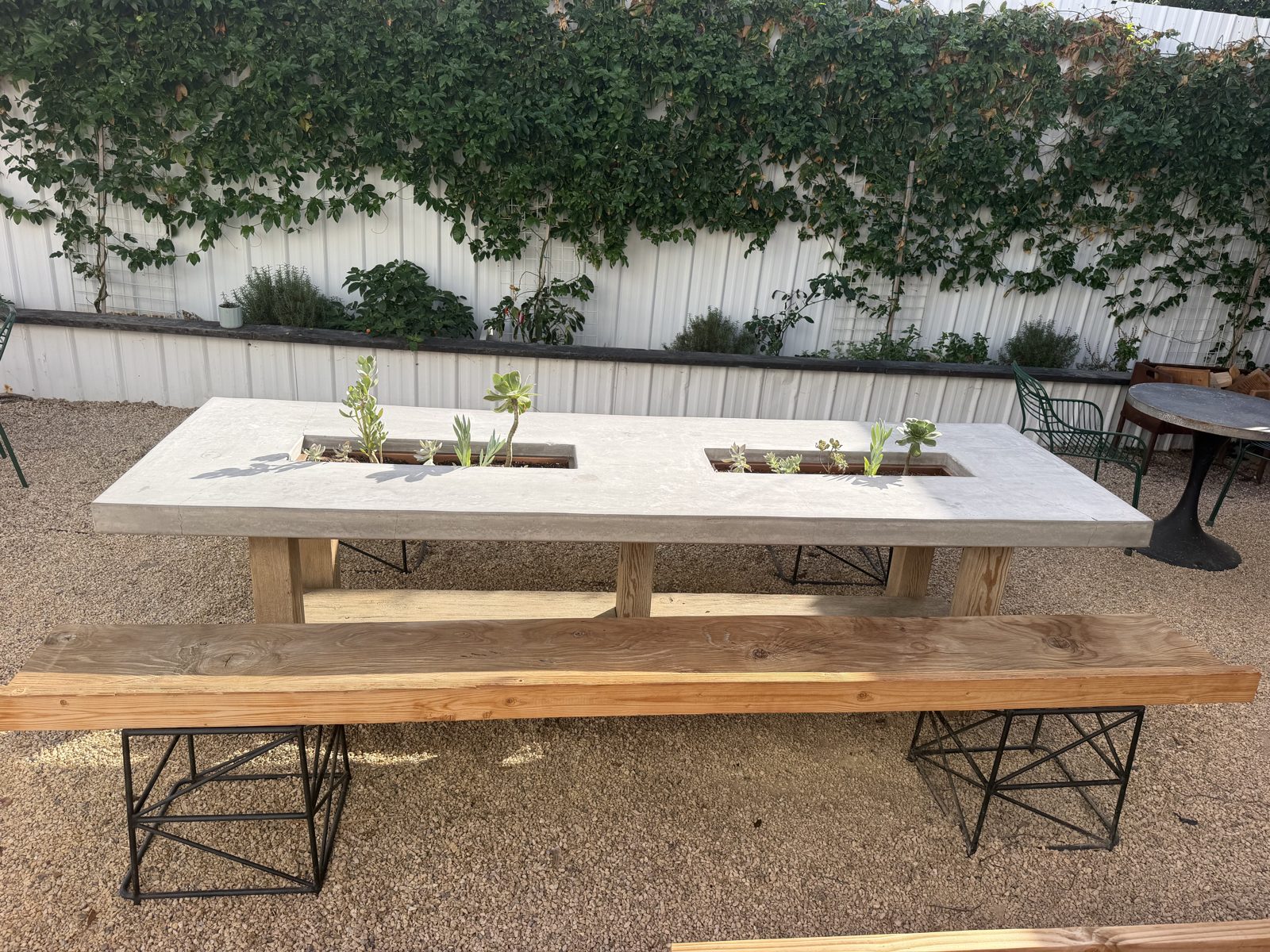
  • Cast concrete table with two recessed planter troughs of succulents, timber legs and a timber bench in front.
    M-03 · Concrete

    Architectural cast concrete

    Communal table with inset native planter troughs.

03System Anatomy

Built Sustainably & for Modular Use.

Hover or tab through the components to isolate them. Each installation still requires site-specific engineering and permitting.
Fig. 01 — Core platform, exploded
04Site Scenarios

From the curb to the commons.

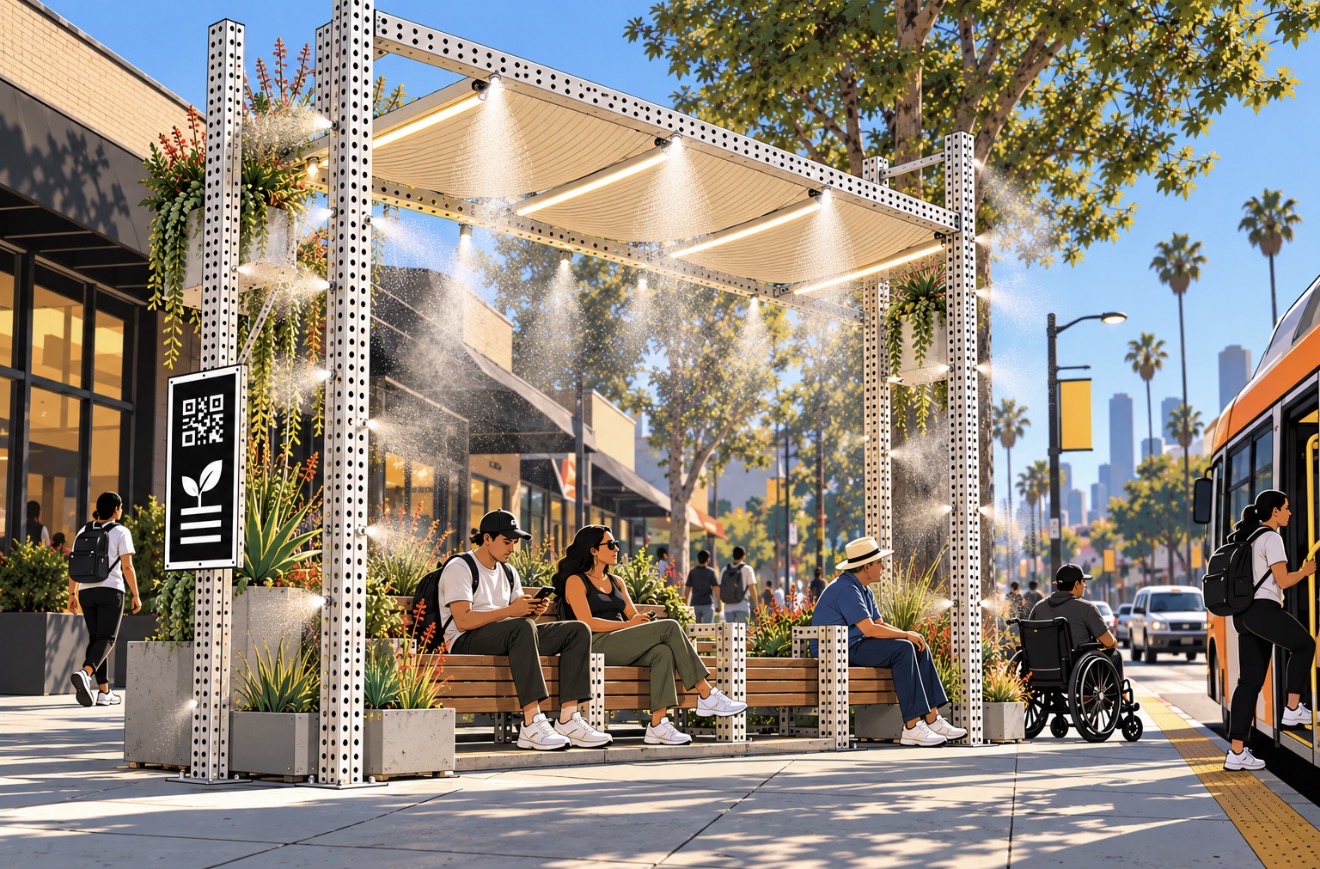
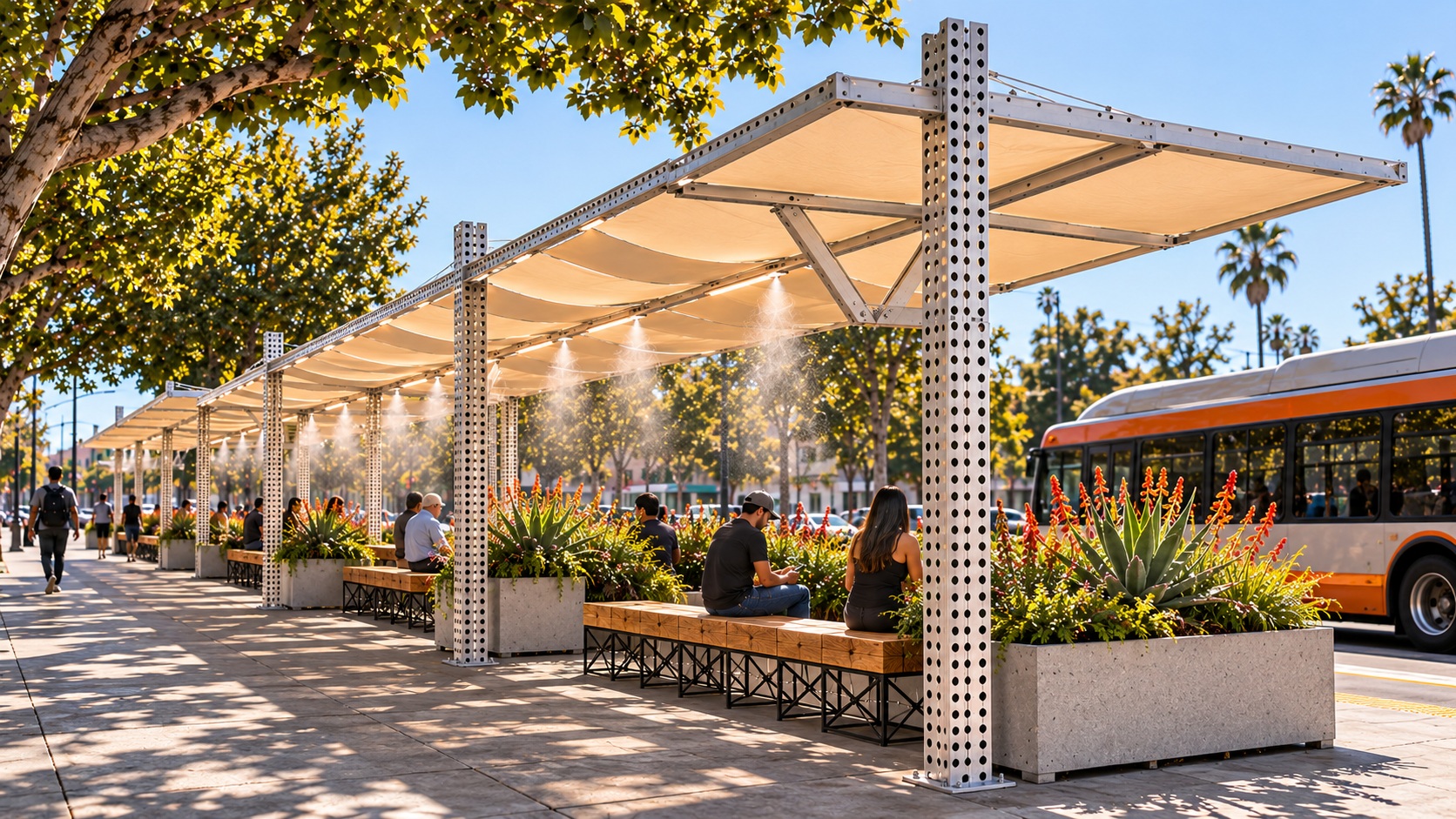
Concept study of a multi-bay transit canopy with perforated steel uprights, fabric shade panels, illustrative misting, planter troughs and timber benches on truss bases alongside a bus lane; not a built installation.

Transit corridor · Concept

Modern transit canopy with mist and planters

A linear, multi-bay shade structure alongside an active bus lane, pairing planter troughs and reclaimed timber benches on steel truss bases with illustrative misting. Repeated bays explore a continuous shaded waiting corridor.

Concept study only — not a built installation or field result.

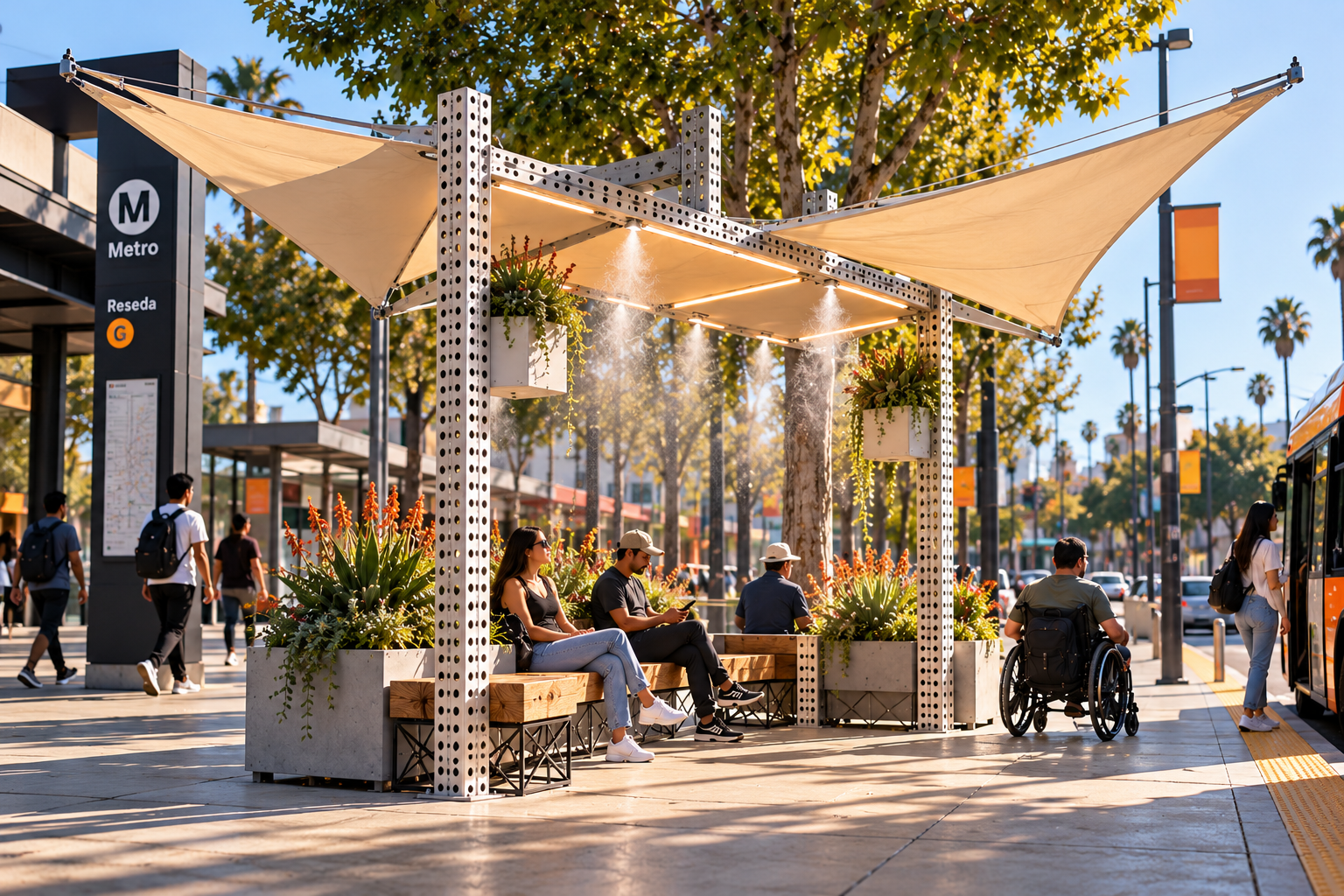
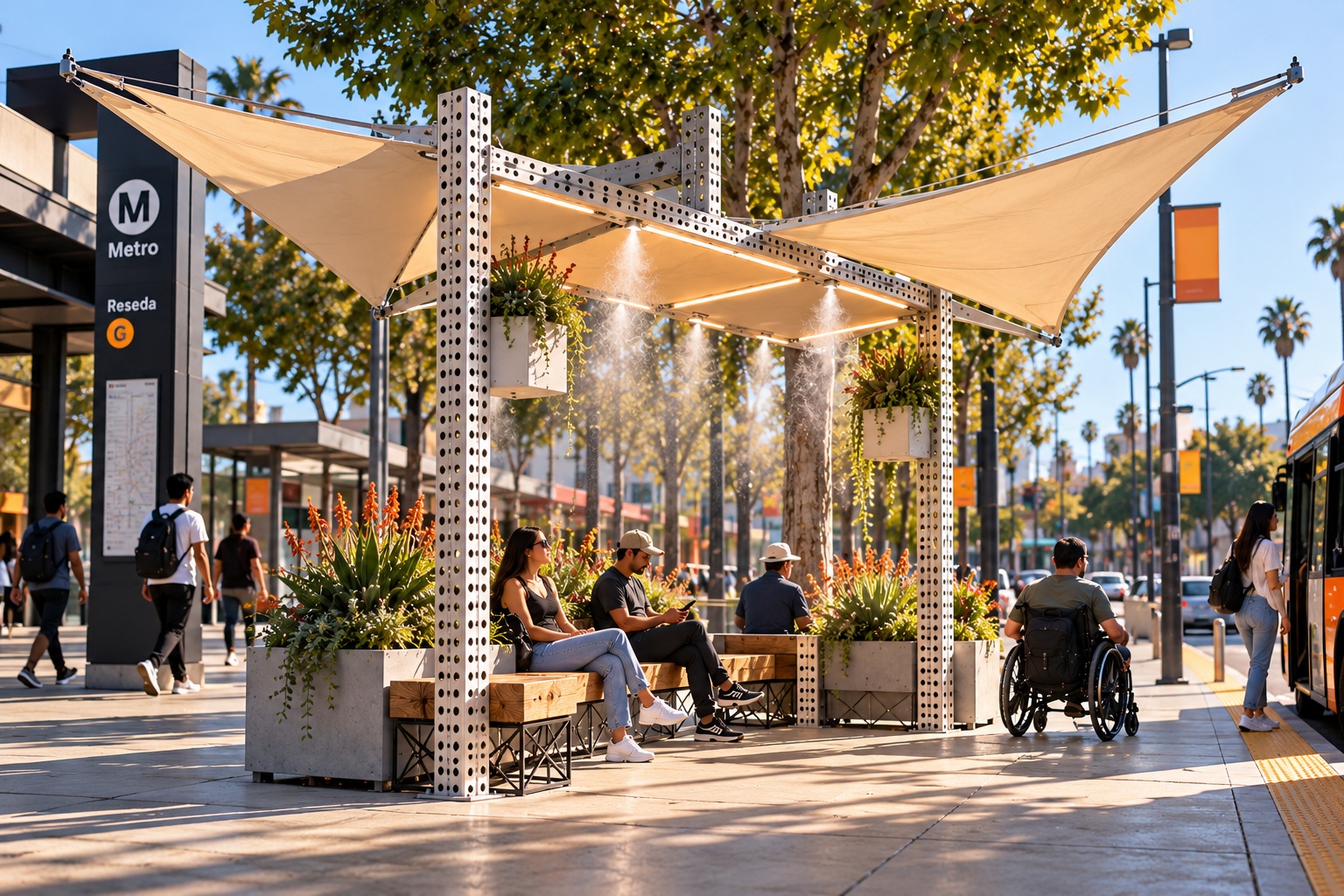
Concept study of a compact canopy adjacent to a Metro stop, with tensioned fabric shade, illustrative misting, planters, timber seating and a wheelchair companion space; not a built or approved Metro installation.

Rapid transit stop · Concept

Compact Metro mist canopy at sunset

A compact bus rapid transit stop study with tensioned fabric shade, illustrative misting nozzles, planting and timber seating. A dedicated wheelchair companion space explores an inclusive waiting arrangement adjacent to a Metro stop.

Concept study only — not a built installation or field result.

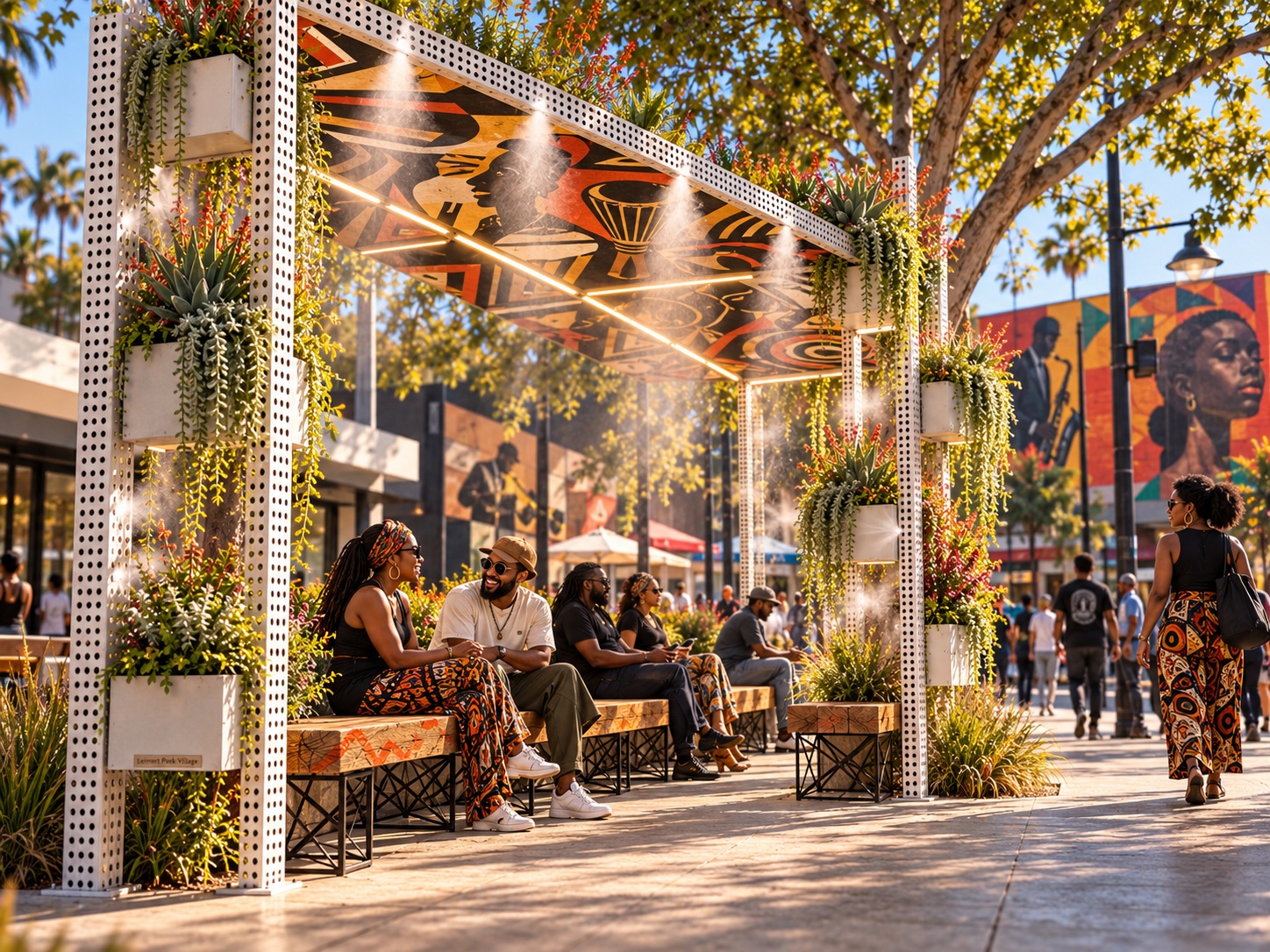
Concept rendering of a transit-adjacent neighborhood public space with an artwork canopy, perforated steel uprights, timber benches, planting and illustrative misting; not a built installation.

Transit-adjacent · Concept

Transit-adjacent public space

A neighborhood gathering and waiting space pairing artist-designed canopy panels, timber seating and planting with optional cooling, coordinated with the transit agency and controlling jurisdiction.

Concept study only — not a built installation or field result.

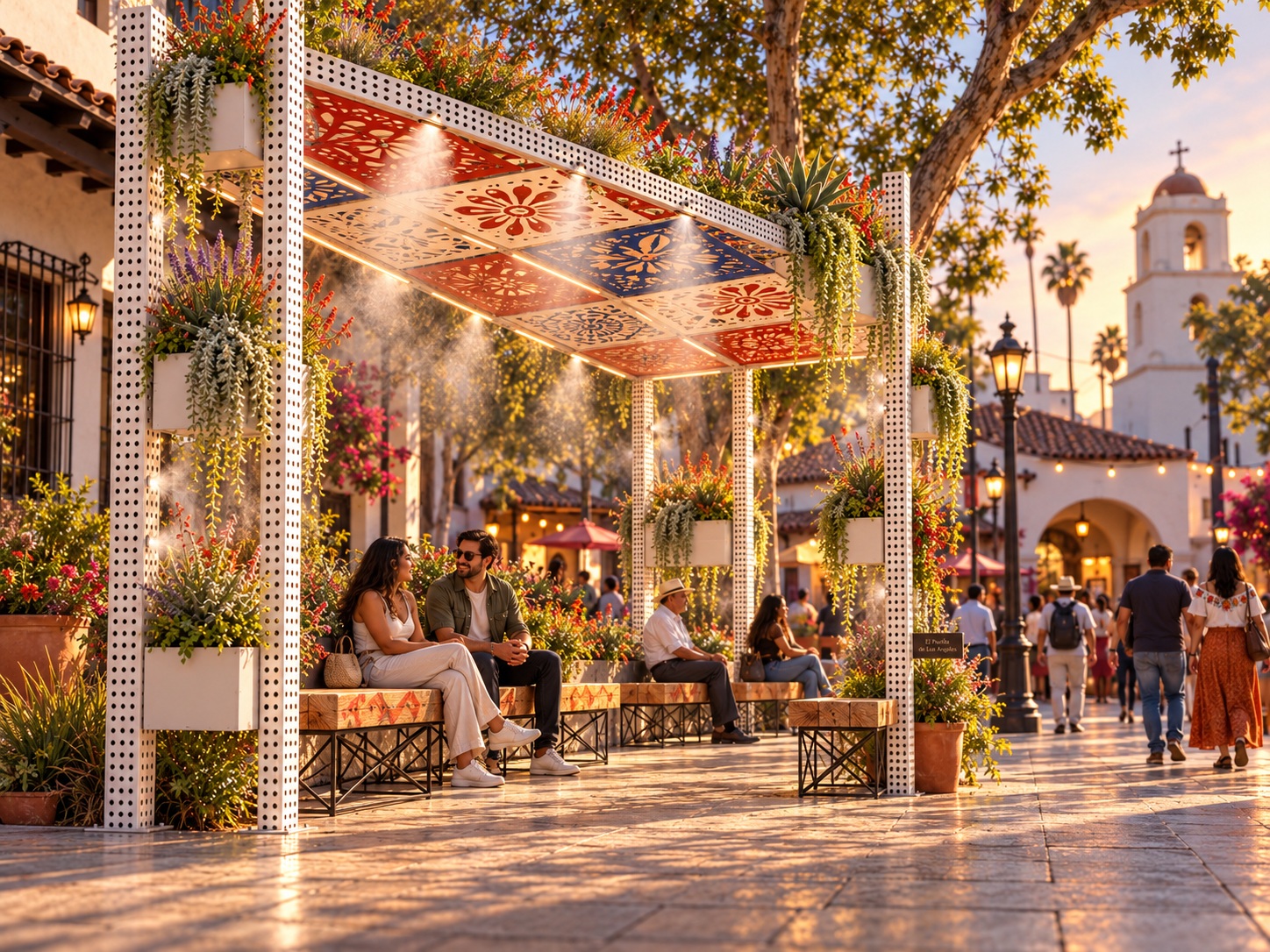
Concept rendering of a plaza with a floral artwork canopy, perforated steel uprights, timber seating, planting and illustrative misting; not a built installation.

Plaza / Commons · Concept

Plaza / commons setting

A shared civic setting bringing shade, seating, cultural artwork and planting together, with optional cooling explored for site-specific conditions.

Concept study only — not a built installation or field result.

Concept renderings — not built installations or field results. Planting and optional cooling are illustrative and subject to engineering, accessibility, maintenance and public-health review. Actual studio fabrication is shown separately in the Platform, System Anatomy and Pilot sections.

05Water + Spout

Water Infrastructure Without a Water Line

A public misting and cooling prototype developed with Spout

Atmospheric Misting + Water Module

A public misting and cooling prototype developed with Spout for integration into our modular climate-infrastructure platform, with potential hydration and accessibility uses.

The module will explore controlled public misting for heat relief, atmospheric water production, secure storage, weather-resistant equipment integration, alternative power and real-time performance monitoring without requiring a permanent municipal water-line connection. Accessible bottle refilling is a proposed secondary use.

The pilot will measure mist output and coverage, water production, energy use, water quality, environmental conditions, public demand, equipment reliability and maintenance requirements across Los Angeles operating conditions.

Development stage
Purpose-built prototype proposed for collaborative engineering and testing.

Access to water remains one of the greatest barriers to expanding hydration and cooling infrastructure across Los Angeles. Traditional systems often require trenching, permanent plumbing, utility coordination and costly site work.

Solving a problem with local innovation.

Together with Spout, we propose designing and testing a purpose-built atmospheric misting and water module for our modular public-space infrastructure platform. The system will draw moisture from ambient air and convert it into filtered water for public cooling, with mineralized drinking water as a proposed secondary use — all without relying on a permanent municipal water connection.

This is not a countertop appliance placed inside a pavilion. We will redesign the technology around the demands of public space.

The prototype will explore

Production + access

  • Controlled public misting for heat relief
  • Higher-capacity atmospheric water production
  • Accessible dispensing controls
  • Proposed public bottle-refill access

Equipment + power

  • Secure, weather-resistant equipment housing
  • Solar, battery and grid-power options
  • Controlled drainage
  • Protection from heat, vandalism and contamination

Monitoring + service

  • Real-time water-quality monitoring
  • Flow, filter and tank-level sensors
  • Remote equipment diagnostics
  • Replaceable service components

Air becomes a local water source

Spout’s existing technology establishes the foundation. Its current system draws air through MERV-13 filter media, condenses moisture, processes the collected water through six filtration stages and adds calcium and magnesium.

Our prototype will adapt that core approach for a new operating environment: public-facing climate infrastructure.

The structure will provide the physical framework for shade, accessible seating, hydration, power, equipment protection, environmental sensing and cultural expression. Spout will provide the atmospheric water expertise that makes plumbing-independent hydration possible.

Spout’s existing technology · Foundation for adaptation

  1. 01

    Air intake

    MERV-13 filter media

  2. 02

    Condensation

    Moisture collected from air

  3. 03

    Filtration

    Six filtration stages

  4. 04

    Mineralization

    Calcium + magnesium

Designed for the site

Atmospheric water production changes with temperature and humidity. The prototype will use environmental data to understand when and where the system can operate most effectively.

Sensors will measure

  • Ambient temperature
  • Relative humidity
  • Water production
  • Water consumption
  • Energy use
  • Storage levels
  • Filter condition
  • System uptime
  • Heat exhaust
  • Maintenance requirements

AI-assisted monitoring will compare these measurements, detect abnormal performance and help operators plan maintenance.

One water platform. Multiple potential uses.

The prototype will prioritize controlled public misting for heat relief, with accessible bottle refill as a proposed hydration use.

Future testing may also evaluate separate water pathways for:

  • Proposed bottle-refill hydration
  • Irrigation
  • Emergency hydration
  • Temporary major-event deployments

Drinking water, misting water and irrigation water will remain separate unless engineering and public-health review approve a shared system.

What we intend to prove

The prototype will answer clear operating questions:

  1. 01

    How effectively does controlled misting lower perceived temperature at public sites?

  2. 02

    How much water can the system produce across Los Angeles microclimates?

  3. 03

    How much energy does each gallon require?

  4. 04

    Can solar or battery systems support meaningful operation?

  5. 05

    How should the system store and dispense water safely?

  6. 06

    How often do filters and service components require attention?

  7. 07

    What ventilation does the equipment need?

  8. 08

    What does reliable public operation cost?

  9. 09

    Which sites provide the strongest combination of need and atmospheric conditions?

  10. 10

    Can one modular system support hydration, shade and cultural programming without permanent plumbing?

This is not simply a water appliance.

It is a new model for distributed, measurable and site-responsive public hydration infrastructure.

“Spout transforms air into water. Our platform transforms that technology into public infrastructure.”
06Pilot Roadmap

Let’s build the first pilot.

  1. 01

    Studio Prototype at Small Green Door

    Assemble a full-scale bay to test structure, canopy geometry, seating, lighting and public interaction.

    Restored white perforated steel uprights and beams standing partially assembled in the Small Green Door studio yard.
    F-01 · Steel uprights & beamsRestored frame in assembly, studio yard
    Long reclaimed solid timber bench resting on two welded black steel truss bases, on gravel.
    R-03 · Bench seatingReclaimed solid timber on welded steel truss base
    Cast concrete table with two recessed planter troughs of succulents, timber legs and a timber bench in front.
    Commons · Planter tableCast concrete top with integrated native planter troughs
  2. 02

    Permitted Civic Pilot

    Install at a partner site with professional engineering, permitting and an agreed operations and maintenance plan.

Partner intake

No account required.